
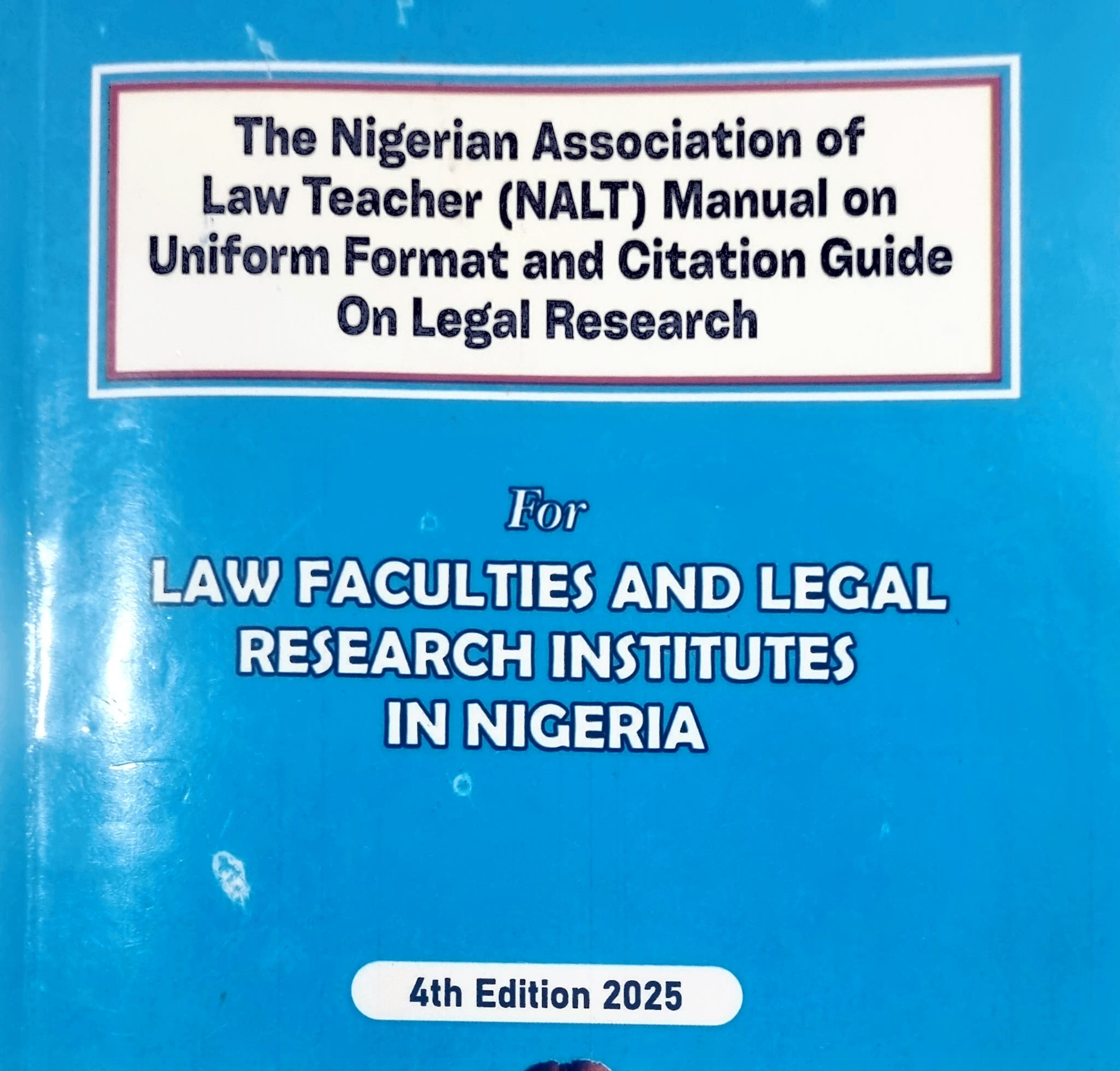
A style Manual earns its authority through impeccable internal consistency. When a guide whose entire purpose is to standardise research writing cannot maintain consistency across its own pages, when it contradicts itself on basic numerical specifications, misspells the headings it prescribes, violates its own citation rules in its own worked examples, and presents structural templates that conflict with the explanatory notes beside them, that authority is fundamentally compromised.
The NALT Uniform Format and Citation Guide, 4th Edition (2025), is exactly such a document. What follows is a systematic accounting of its errors, and it is not a short one. All page and section references are to the 4th Edition 2025.
Part I: The Literature Review Lacuna - An Undergraduate's Invisible Chapter
The most consequential structural defect concerns the Literature Review for undergraduate long essays. The Manual's explanatory notes are unambiguous. For instance, page 29, under 'Chapter One: Introduction,' explicitly states that the chapter's contents include:
Background to the Study, Statement of the Research Problem..., Research Methodology, (Literature Review inclusive for undergraduate only), and Synopsis of the Chapters.
This is a significant prescription. Literature Review is designated as a component of Chapter One, but only for undergraduates; meaning, undergraduates follow a structure of Chapter One different from postgraduate students. That distinction has real pedagogical implications.
However, the problem is that the Chapter One structural template (the actual numbered outline that students are supposed to follow) at pages 24–25 contains no Literature Review section whatsoever. The template outlines the structure of Chapter One as follows:
1.1 BACKGROUND TO THE STUDY
1.2 STATEMENT OF PROBLEM
1.3 AIM AND OBJECTIVES OF THE STUDY
1.4 SCOPE AND LIMITATIONS OF THE STUDY
1.5 SIGNIFICANCE OF THE STUDY
1.6 RESEARCH METHODOLOGY
1.7 CHAPTERS ANALYSIS
Seven sections are listed. Literature Review is excluded as no section number is assigned to it. No indication is given of where it falls in the sequence. Although the explanatory notes say it exists, the template says otherwise. An undergraduate student following the template would produce a Chapter One with no Literature Review; the same student reading the explanatory notes would know it should be there but would have no idea where to place it or what to label it. This becomes more confusing as the outline of Chapter Two set out at page 25 of the Manual lists "Literature Review" under item 2.3 without any specification of it being applicable solely to post graduate students whatsoever.
This is not a marginal omission. For undergraduate students, the largest group of users of this manual, the structure of Chapter One is the single most fundamental question the Manual must answer. It answers it in two incompatible ways.
Part II: The Abstract - Three Different Answers in One Document
The word count for the research abstract is a basic, verifiable specification. The Manual provides at least three irreconcilable sets of figures across five separate locations:
- Section 2.1(h): 'not more than 300 words for undergraduate, 500 words for master and 600 for PhD.'
- Section 2.3.1(iv) (Undergraduate Long Essay): 'should not be more than 200-350.'
- Section 2.3.2(f) (Master's Dissertation): 'not more than 400-500 words.'
- Section 2.4.2 (Abstract Guidelines): 'not more than 300-400 words for undergraduate, 500-600 words for post graduate.'
- Section 5.2.1(v) vs. Section 2.4.2 (journal articles): '200-250 words' in Chapter Five; '250-300' in Section 2.4.2, a contradiction within a single topic.
No explanation is offered for these variations, no hierarchy of rules is established, and no section cross-references another. Students and supervisors consulting different parts of the Manual in good faith will arrive at different, formally incompatible conclusions.
Part III: The Master's Page Count Minimum - Two Figures, One Chapter
Section 2.1(c) at page 9 of the Manual prescribes:
80 minimum and 150 maximum pages for master dissertation.
Section 2.3.2(b), at page 12 of the Manual in the same chapter, prescribes:
100 pages minimum and 150 pages maximum.
Although the maximum is consistent, the minimum is not. An 85-page master's dissertation is compliant under Section 2.1 and non-compliant under Section 2.3.2. The Manual provides no reconciling principle.
Part IV: Non-Doctrinal Chapter Two - Numbered as if It Were Chapter One
At page 39, the structural template for the non-doctrinal approach presents Chapter Two as follows:
CHAPTER TWO CONCEPTUAL AND THEORETICAL FRAMEWORK AND LITERATURE REVIEW
1.1 CONCEPTUAL CLARIFICATIONS
1.2 THEORETICAL AND HISTORICAL FOUNDATION
1.3 LITERATURE REVIEW
Every sub-section of Chapter Two is numbered with the prefix '1', as though they belong to Chapter One. The correct prefixes should be 2.1, 2.2, and 2.3. The very next page then provides the breakdown of those same sub-sections using the correct numbering: 2.1, 2.1.1, 2.2, 2.2.1, 2.2.2, 2.3. The template and the breakdown of the same template are therefore numbered differently within the space of two facing pages.
Part V: Non-Doctrinal Chapter One - 'Statement of the Problem' Vanishes
The non-doctrinal Chapter One template (page 39) lists six sub-sections: Background to the Study, Research Hypothesis, Purpose of the Study, Scope and Limitation, Significance of the Study, and Synopsis of the Chapters.
However, the explanatory notes for the same chapter at pages 41–42 of the Manual list eight distinct components, including '(2) Statement of the Problem' as a separate, substantive sub-section sitting between Background to the Study and Purpose of the Study. The Statement of the Problem does not appear anywhere in the template. The template at page 39 jumps directly from 1.1 (Background) to 1.2 (Research Hypothesis).
This is not a naming variant. The Statement of the Problem is a recognised methodological component explaining the knowledge gap the research addresses. In the doctrinal template at page 24 of the Manual, it appears as section 1.2. In the non-doctrinal template it simply vanishes. A student following the non-doctrinal template would produce a Chapter One structurally omitting one of its prescribed parts.
Part VI: The Conclusion Templates - Incompatibly Numbered Across Approaches
The doctrinal conclusion template at page 28 reads:
5.1 SUMMARY OF FINDINGS
5.2 RECOMMENDATIONS
[5.3 — OMITTED]
5.4 CONTRIBUTIONS TO KNOWLEDGE
5.5 AREAS FOR FURTHER STUDIES
5.6 CONCLUSION
Section 5.3 is missing. Five components are given but numbered as six, running from 5.1 to 5.6 with an unexplained gap. The non-doctrinal conclusion template (page 40) covers the same chapter and correctly presents:
5.1 SUMMARY OF FINDINGS
5.2 RECOMMENDATIONS
5.3 CONTRIBUTION TO KNOWLEDGE
5.4 SUGGESTED AREAS FOR FURTHER STUDIES
5.5 CONCLUSION
Five components, numbered consecutively 5.1–5.5 with no gap. Both templates ostensibly describe the same five-element concluding chapter. Additionally, the doctrinal version spells the third component 'CONTRIBUTIONS TO KNOWLEDGE' (plural) while the non-doctrinal version uses 'CONTRIBUTION TO KNOWLEDGE' (singular), different renderings of the same prescribed section title.
Part VII: 'Chapters Analysis' versus 'Synopsis of the Chapters'
The final sub-section of Chapter One carries two different names in the same document. In the doctrinal template (page 25), it is numbered 1.7 CHAPTERS ANALYSIS. In the non-doctrinal template (page 39), the equivalent section is 1.6 SYNOPSIS OF THE CHAPTERS. The explanatory notes on page 29 use 'Synopsis of the Chapters.' Some presidential speeches in the preliminary pages use 'Chapters Analysis.'
Not only is the label inconsistent; the section number differs (1.7 doctrinal, 1.6 non-doctrinal), reflecting a structural difference in how many sub-sections precede it. The Manual provides no note reconciling these variants.
Part VIII: Terminology Inversion - 'Master's Thesis' and 'PhD Dissertation'
Section 2.3 at page 11 of the Manual introduces the three categories of research writing with this list:
a. Undergraduate final year long essay research project, b. The master's thesis and c. PhD dissertation.
This is the precise inverse of established convention, and of the manual's own consistent practice throughout every other section. Everywhere else in the document, master's work is a 'dissertation' and doctoral work is a 'thesis.' The subsection headings immediately following, 2.3.2 'Guidelines on master's degree Dissertation' at page 12 and 2.3.3 'Guidelines on PhD Thesis' at page 13, correct the error. But the introductory list at Section 2.3, which many readers encounter first, gives the terms in reverse.
Part IX: 'BIBLIOGRAHPY' - Prescribing a Misspelled Heading
The Manual provides at page 22, particularly section 2.4.3 explicitly as follows:
It is titled, 'BIBLIOGRAHPY' on a separate page.
The correct spelling is BIBLIOGRAPHY. The error is not in passing commentary; it is the prescribed heading itself. A PG/undergraduate student following this instruction would submit work with a misspelled section title. The correct form 'BIBLIOGRAPHY' appears correctly spelt in other parts of the Manual, making the error in the prescriptive instruction all the more striking.
Part X: 'APENDICES' - A Misspelled Section Heading
At page 87 of the Manual, the formal section header for the Appendices reads 'APENDICES.' The correct form is 'APPENDICES.' The first 'P' is omitted. This heading appears in the published document despite multiple rounds of committee review across four editions.
Part XI: The Manual Violates Its Own Abolition of passim
The Manual provides at section 4.3 at page 66 states plainly:
The following Latin expressions have been abolished or jettisoned in NALT citation style: supra, infra, ante, contra, id, op cit, loc cit, passim, et seq.
At page 70, in a worked bibliography example presented as a model for readers:
J. A. Arewa, 'Nigeria's National Security Challenges...', 2 NIALS Journal of Law and Public Policy, passim, (2012)
The word passim which is specifically abolished is used as a citation signal in a worked example three pages after it is prohibited. A PG/ Undergraduate student reading both passages cannot determine whether the term is permitted or not.
Part XII: Section Misnumbering in the Core Citation Chapter
Page 55 presents '4.2. NALT Citation Proper.' The first sub-section immediately below is titled '5.2.1 Citation of Primary Sources'; the number '5' is plainly a carry-over error from an earlier draft. The sequence then continues at page 57 with '4.3.2 Citation of Secondary Sources,' with no 4.3 or 4.3.1 ever having appeared. The section numbering in the core citation chapter therefore runs: 4.2 → 5.2.1 → 4.3.2 incoherent across three consecutive entries.
Part XIII: The Quotation Length Threshold - Lines or Words?
Section 4.4 (main citation chapter) uses only a line count: short quotation is 'not more than three lines of the researcher's work.'
Section 5.2.1(xiii) (journal article chapter) introduces a word count alternative not present in Chapter Four: 'Quotation less than 3 lines or 40 words should be placed within the text.'
Three lines and forty words are not the same threshold in practice. A dense legal quotation might fit within three lines but exceed forty words; a sparse one might be under forty words but run to four lines depending on font and margin settings. The two standards produce different results in edge cases, and the manual provides no guidance on which rule takes precedence.
Part XV: Inconsistent Bracket Style for Year Citations
The Manual permits 'round or square brackets' for the year in journal citations without explaining when each applies. The worked examples do not fill this gap; they compound it. Some examples use round brackets like (2023), (2011) while others use square brackets, [2005], [2012], [1999]. No principle distinguishes the usage. OSCOLA uses square brackets for years that identify the volume; round brackets for years that are merely dates. NALT acknowledges neither rule nor distinction, leaving legal researchers & students to guess.
Part XVI: 'Chronological Alphabetical Listing' - A Direct Contradiction
Section 3.2.3 at page 22 of the Manual defines bibliography as:
the chronological alphabetical listing of the various sources consulted.
A chronological bibliography lists sources in order of publication date, usually from oldest to newest (earliest to latest), while a bibliography is ordered alphabetically by the surname of the first author. These two organising principles are mutually exclusive: a chronological listing orders by date; an alphabetical listing orders by author surname. Section 4.5 at page 69 correctly describes alphabetical ordering by surname, but the contradiction in Section 3.2.3, which students learning the non-doctrinal approach would consult, goes uncorrected.
Part XVII: 'etal' - A Latin Abbreviation Written as a Single Word
The quick citation summary on page 53, particularly paragraph k instructs:
If authors are more than 3, put the 1st author's name and add, etal
The atin abbreviation should be written 'et al.', two words, with a full stop after 'al.' The manual elsewhere correctly uses 'and others' as the preferred NALT style for multiple authors at page 78, but this quick guide presents 'etal' (one word, no full stop) as an acceptable shorthand. It is not.
Part XVIII: A Case Name Spelled Differently Within the Same Sentence
At page 55, under 'Unreported Cases,' a hypothetical case is styled as 'Ekoebor v Police Council (2003) LRCN 107.' In the very same paragraph, the suggested short-form citation reads 'in Ekeobor's case', with a different spelling. The Manual uses 'Ekoebor' in the full citation and 'Ekeobor' in the abbreviated form within the span of three sentences, without any acknowledgment of the discrepancy.
Part XIX: Double Quotation Marks in a Single-Quote Regime
Section 4.4 prescribes that short quotations be 'enclosed into single quotation marks.' The general citation rules consistently use single quotes for article and chapter titles throughout. Yet page 60, in a worked example for citing a chapter in a book, uses double quotation marks:
Akper, P.T. "Nigeria and Her Neighbors: The Contribution of the Lake Chad Basin Commission to Sub-Regional Security and Stability" In Taiwo Kupolati (ed)...
The example violates the typographical rule it is meant to illustrate.
Part XX: Font Name Inconsistency Across the Document
The font prescription for all research documents appears in three different forms:
- Page 9 (Section 2.1(e)): 'Time Roman with font size of 12'
- Pages 12–13 (Sections 2.3.1 and 2.3.2): 'Times New Roman'
- Page 77 (Chapter Five): 'Time New Roman font 12'
'Time Roman,' 'Times New Roman,' and 'Time New Roman' are three different strings, of which only one 'Times New Roman' is the correct name of the font. A legal researcher/student submitting a document in Times New Roman while a supervisor checks against 'Time Roman' would have no authoritative text to resolve the challenge.
Part XXI: 'Three Distinct Areas / Four Major Parts' - A Numerical Self-Contradiction
Page 6 of the Manual states:
The Manual has three distinct areas divided into four major parts.
Four numbered parts then follow. 'Three' and 'four' cannot both be correct. This self-contradiction appears in the section introducing the manual's structure to first-time readers, the worst possible location for a numerical error. No footnote or subsequent passage resolves it. It is therefore, necessary to define the 'three distinct areas' before outlining the major parts.
Part XXII: Place of Publication - Three Treatments, No Rule
The Manual never states whether place of publication is required, optional, or prohibited in textbook citations. That silence would be tolerable if the worked examples are uniform; they are not. The textbook citation at pages 57–58 includes the place of publication embedded within the publication bracket but positioned after the publisher's name: (Ahmadu Bello University Press Limited Zaria 2017). The citation at page 78 positions the place of publication before the publisher's name and separates the two with a colon: (Port Harcourt: Institute of Human Capacity Development and Continuing Education, 2018). A third group of worked examples on the same page omits place of publication entirely: (Malthouse Press, 2020); (Sweet & Maxwell 2012). All three treatments appear within the same chapter, presented without distinction and without any explanatory note. A researcher consulting pages 57–58 alone would include the place of publication after the publisher; one consulting page 78 alone might include it before, or omit it altogether. OSCOLA, which NALT expressly adapts, resolves this by omitting place of publication entirely. NALT neither adopts that rule nor articulates its own, leaving the three irreconcilable examples to stand as the de facto guide, which is no guide at all.
Conclusion: A Manual That Must Hold Itself to Its Own Standard
The Manual is attempting something genuinely important: providing Nigerian legal education with an indigenous, standardised research framework. The ambition is right, and the intellectual labour invested by the Drafting Committee and the Implementation and Monitoring Committee over more than a decade deserves full acknowledgment.
But a Manual whose own pages contain misspelled headings, phantom section numbers, contradictory word counts, impossible dates, and structural templates that disagree with their own explanatory notes cannot credibly demand precision from researchers/students . Several of the defects catalogued here go to the structural core of what the manual exists to specify: the missing Literature Review in the undergraduate template, the three-way abstract word count contradiction, the gap at section 5.3 in the doctrinal conclusion template, the non-doctrinal Chapter Two numbered as if it were Chapter One. Others, the passim violation, the two impossible years surviving four editions, 'BIBLIOGRAHPY' and 'APENDICES' reflect an editing process insufficient to the task.
Thus, the 5th Edition should begin not with new content but with a thorough, structured self-audit: every numbered prescription cross-checked against every other; every worked example verified against the rule it illustrates; every section heading proofread. The manual asks Nigerian Law teachers, researchers and law students to meet a standard of accuracy it does not itself meet. Closing that gap is the first and most urgent task.
Click here to download the 4th Edition of the NALT Guidelines as published in 2025